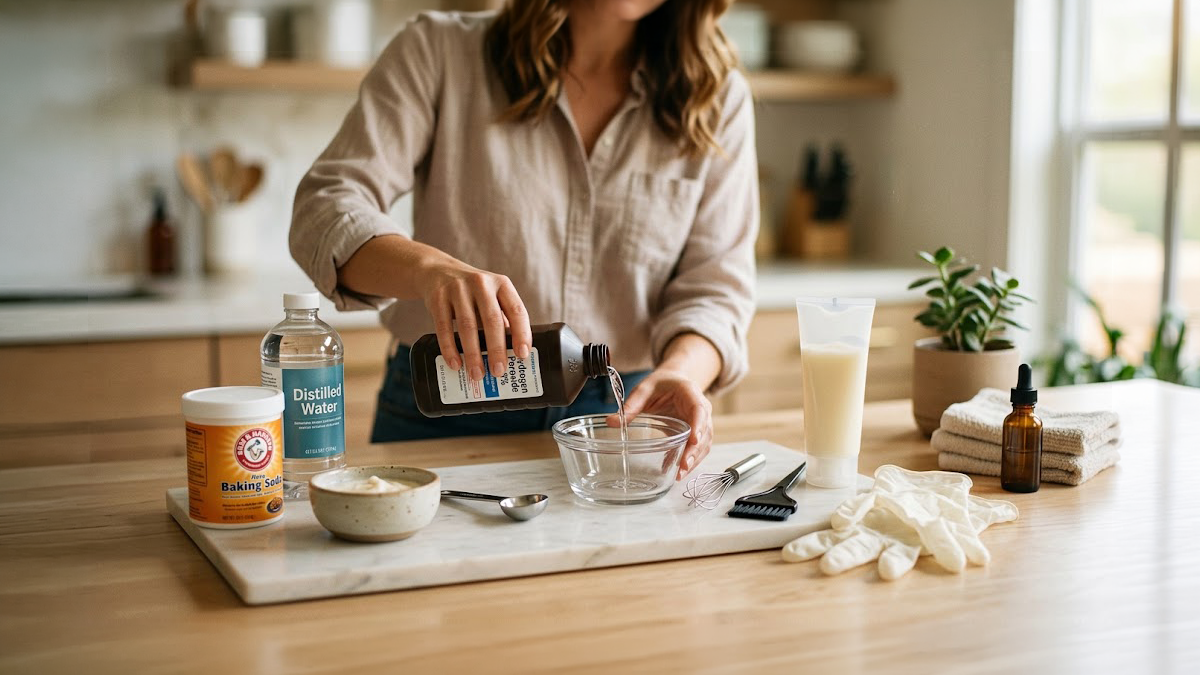
Ran out of developer halfway through a dye job? Here’s the short answer: you can’t make developer from pantry ingredients, because developer is hydrogen peroxide. But plain 3% hydrogen peroxide from the drugstore works as a 10-volume substitute for a quick root touch-up or a deposit-only color.
Below you’ll find what developer is made of, how to use drugstore peroxide safely, a few gentle natural lightening options, and when to leave it to a colorist.
What Is Hair Developer Made Of?
To understand whether you can substitute or formulate a developer at home, you must first understand what commercial hair developer (frequently called oxidant or oxidizing lotion) actually does during the hair coloring process.
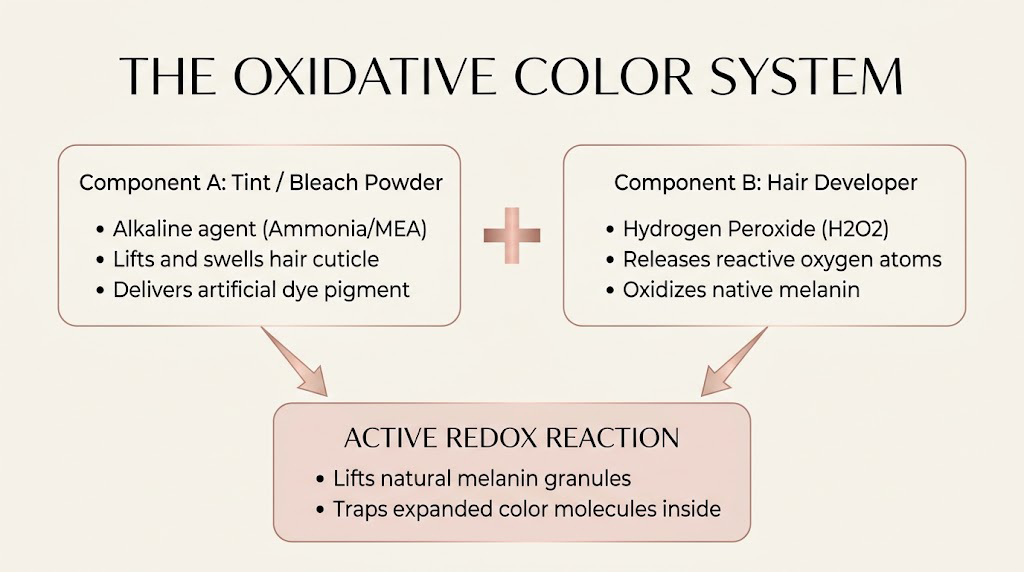
Hair developer consists of hydrogen peroxide (H2O2) blended with stabilizing agents, water, and conditioning bases. When mixed with permanent hair color or bleach powder, an immediate chemical reaction occurs:
- Alkaline Swelling: The alkaline agent (often ammonia or ethanolamine) in the dye opens up the tightly packed shingles of the hair cuticle.
- Peroxide Infiltration: The developer penetrates deep into the inner cortex of the hair shaft.
- Oxygen release: Hydrogen peroxide is unstable, so it breaks down and releases oxygen inside the hair.
- Melanin Oxidation: This liberated oxygen oxidizes and disperses the natural melanin granules responsible for your natural hair color.
- Color Molecule Polymerization: The same oxygen couples tiny dye precursor molecules together, transforming them into complex, giant color molecules that become permanently trapped inside the cortex.
Without an oxidizing activator, permanent hair colors cannot develop their pigments, and lighteners cannot strip dark melanin.
Developer Volumes vs. Percentages: The Concentration Matrix
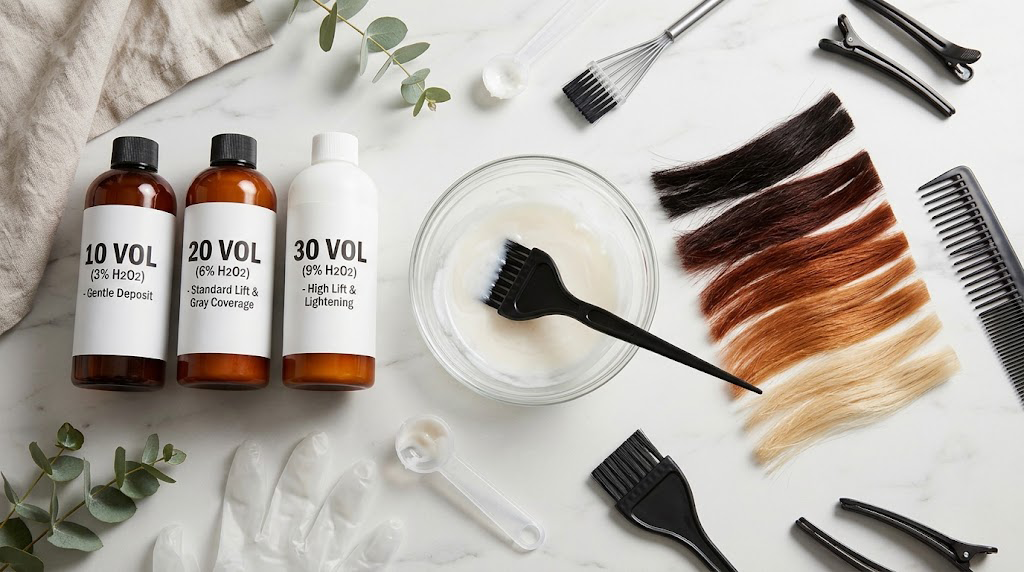
Professional developers are categorized by their “volume” (abbreviated as “Vol”) or their actual percentage of pure hydrogen peroxide. Volume indicates how many liters of reactive oxygen gas can be released by one liter of the liquid formula:
| Volume Rating | Percentage of H2O2 | Lift Level / Action | Ideal Formulation Goal |
| 5-Volume | 1.5% | No lift; deposit only | Pastel glosses, toners, and gentle glazes |
| 10-Volume | 3.0% | Deposit only / Minimal lift (0–1 level) | Darker shades, tone-on-tone coloring |
| 20-Volume | 6.0% | Standard lift (1–2 levels); 100% grey coverage | The industry standard for permanent hair dye |
| 30-Volume | 9.0% | 2–3 levels of lift; bold lightening | Lifting stubborn dark hair or deep brown hair |
| 40-Volume | 12% | 3–4 levels of lift; intense chemical action | High-lift blondes; risky for fine or brittle textures |
Warning on high volumes: 40-volume developer generally isn’t used on the scalp. It’s for off-scalp highlights and is best left to a professional colorist, because it can cause chemical burns and serious breakage.
Can You Truly Make Homemade Hair Developer from Scratch?
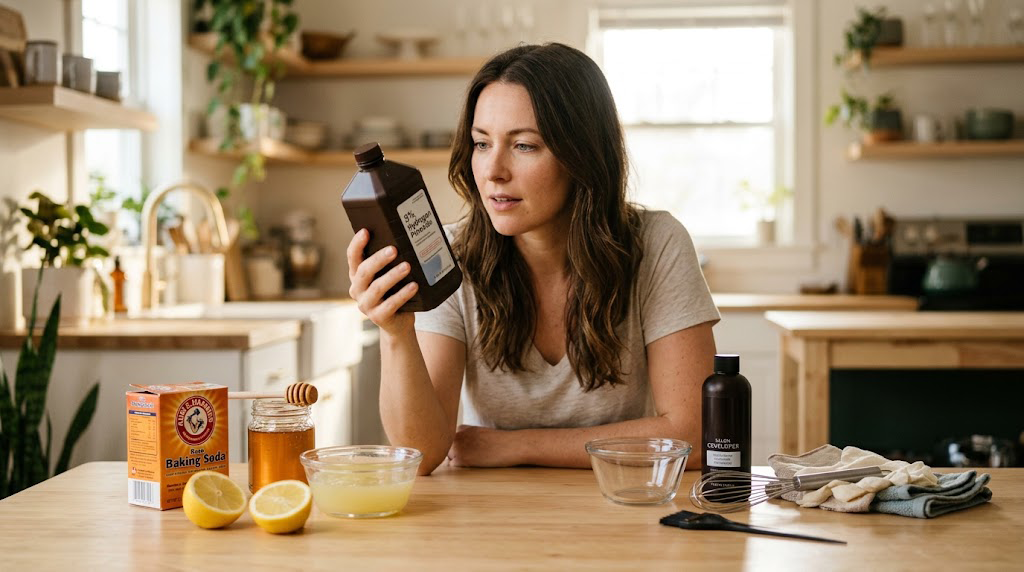
The honest answer from any reputable professional hair stylist or cosmetic chemist is nuanced: You cannot synthesize safe, cosmetic-grade hydrogen peroxide from non-chemical pantry ingredients.
You cannot mash bananas, stir yogurt, or brew tea to produce the precise, stabilized hydrogen peroxide molecules required to activate permanent hair dye. However, you can safely formulate the correct volume developer at home if you have access to medical-grade 3% hydrogen peroxide from your local drug store and need to formulate a gentle, low-concentration activator.
The 3% Medical Peroxide Route (10-Volume Emergency Substitute)
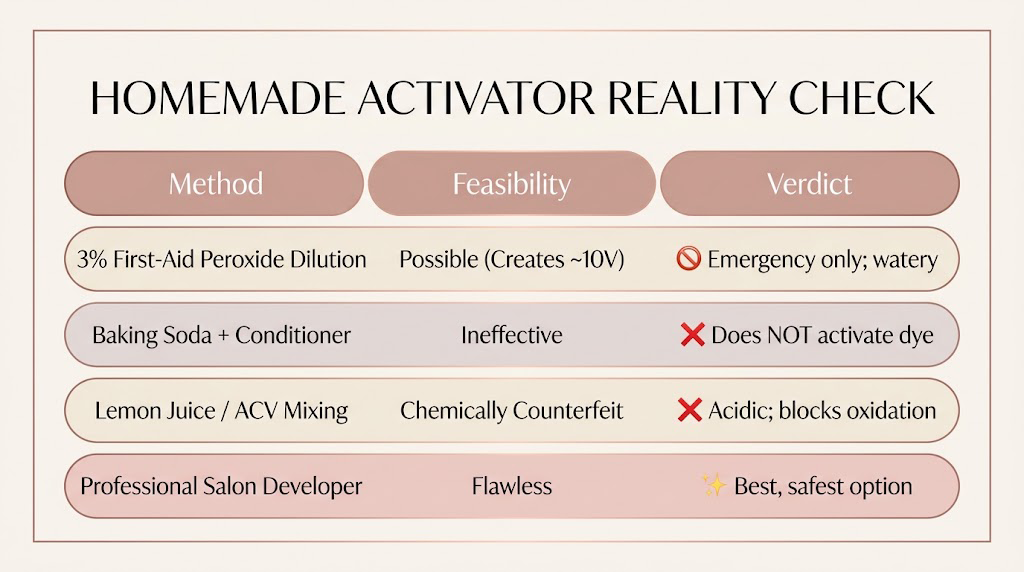
Standard brown bottles of 3% hydrogen peroxide sold at grocery stores and pharmacies contain roughly 10-volume peroxide. Chemically, it possesses the identical active constituent as commercial 10-volume salon developer.
However, medical-grade peroxide is watery. Professional salon developers are formulated as thick, rich creams enriched with emulsifiers, buffers, and fatty alcohols to protect the health of your hair and keep the mixture from dripping down into your eyes or across your skin.
⚠️ Important warning: Drugstore peroxide is thin and runny, and it doesn’t have the conditioning ingredients salon developers do. If you have fine or previously colored hair, be extra careful. Always do a strand test on a hidden section of hair before applying anything to your whole head.
Recipe 1: The “Emergency” Developer (Peroxide + Conditioner)
Best for: Mixing with semi-permanent dye or slight lifting.
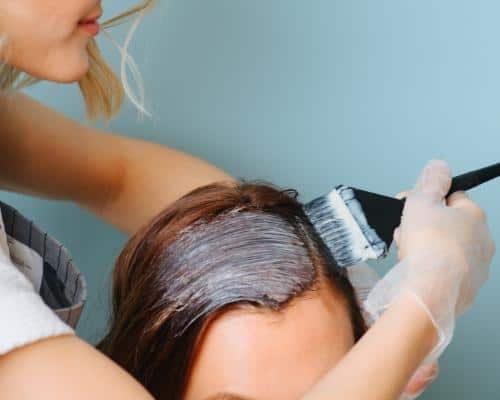
If you have a bottle of 3% hydrogen peroxide in your medicine cabinet, you essentially have a 10 volume developer. This strength is perfect for depositing color or shifting your shade one level lighter.
Ingredients:
- 1/2 cup 3% Hydrogen Peroxide
- 1/2 cup baking soda (optional; gives a small extra lift but is drying)
- 1/4 cup Conditioner (to protect the hair)
Instructions:
- The Mix: In a plastic bowl (never metal, as it reacts with peroxide), mix the hydrogen peroxide and baking soda until dissolved.
- The Buffer: Stir in the conditioner. This helps create a creamy consistency similar to a bottle of developer and provides a buffer for your scalp.
- Application: Use this mixture immediately. Unlike store-bought developer, the chemical reaction in homemade versions degrades quickly.
Note on Strength:
6% Peroxide ≈ 20 Volume Developer (Standard for covering gray hair and lifting 1-2 levels). Note: It is difficult to find 6% peroxide in a standard drug store.
3% Peroxide ≈ 10 Volume Developer (Deposits color, very slight lift).
Recipe 2: The Gentle “Sun-Bleach” Method (Lemon + Water)
Best for: Virgin hair, light blonde highlights, and summer vibes.
If the idea of chemical peroxide scares you, or you just want natural highlights, lemon juice is a classic natural lightening agent. It works by using citric acid to slowly oxidize the melanin, accelerated by UV rays.
Ingredients:
- 1/2 cup Fresh Lemon Juice
- 1/2 cup Distilled Water
- 1 tablespoon Olive Oil (to prevent dryness)
Instructions:
- Mix ingredients in a spray bottle.
- Spray onto damp hair where you want highlights.
- Sit in the sun for 30-60 minutes. The heat and UV light activate the citric acid.
- Deep conditioning is mandatory afterward, as lemon juice is extremely drying.
Reality Check: This will not turn dark brown hair platinum. It will likely shift dark hair to a warm, reddish-brown. It takes much time and multiple sessions to see results.
Recipe 3: The Vitamin C Flush
Best for: Fading semi-permanent dye that came out too dark. It won’t lighten your natural hair color.
This is a popular trick for fading a semi-permanent color you don’t love.
Ingredients:
- 10-15 Vitamin C tablets (crushed into fine powder)
- 1/2 cup dandruff shampoo (sulfates help strip color)
Instructions:
- Mix the powder and shampoo mix until it forms a thick paste.
- Apply to damp hair and cover with a shower cap.
- Let sit for 45 minutes.
- Rinse thoroughly. Vitamin C acts as a mild antioxidant that disrupts color molecules.
Understanding Developer Volumes: Why It Matters
When making or buying developer, “Volume” refers to the concentration of oxygen. Using the right volume developer is critical for your hair goal.
10 Volume (3% Peroxide)
- Use: No-lift or deposit only.
- Best For: Going darker, toning light blonde hair, or sensitive scalps.
- Homemade Equivalent: Standard drugstore hydrogen peroxide.
20 Volume (6% Peroxide)
- Use: 1-2 levels of lift + Gray Coverage.
- Best For: The standard permanent hair coloring strength. It covers grey hair effectively and provides a permanent result.
- Homemade Equivalent: Hard to make safely; requires diluting strong food-grade peroxide (highly risky).
30 Volume (9% Peroxide)
- Use: 2-3 levels of lift.
- Best For: Turning brown hair to a golden blonde.
- Warning: Can cause burns if left too long.
40 Volume (12% Peroxide)
- Use: 4+ levels of lift.
- Best For: High-lift colors.
- Warning: Generally not used on the scalp. Leave it to a professional colorist, and never try to make this strength at home.
DIY Lightening Alternatives Using Gentle Natural Ingredients
If you want to shift your shade subtly without handling raw synthetic chemicals or commercial peroxide, several natural lightening agents can gently nudge your tones lighter over time:
1. Raw Honey and Water
Raw honey produces tiny amounts of hydrogen peroxide when it’s diluted with water. It’s far too weak to lighten dark hair, but it may add a little brightness to light brown or blonde hair over several uses.
- The Recipe: Whisk together 4 parts raw unfiltered honey with 1 part distilled water or raw apple cider vinegar. Let the mixture sit undisturbed at room temperature for 30 minutes to activate the natural enzymes.
- Application: Apply to clean, damp hair, cover with a shower cap and leave on for 1 to 2 hours before rinsing. Expect subtle results at most.
2. Chamomile Tea Rinse
A strong chamomile tea rinse can add a subtle golden warmth to blonde and light brown hair. It won’t do much on darker hair.
- The Recipe: Steep 4 organic chamomile tea bags in 2 cups of boiling water until completely cool.
- Application: Use the cooled, strained tea as a final rinse after shampooing. Repeat regularly for a gradual effect.
Can I Use Vinegar Instead of Developer?
This question comes up a lot: “Can I use apple cider vinegar (ACV) as developer?”
No. Vinegar contains no peroxide, so it can’t activate hair dye or bleach. Don’t mix vinegar with bleach products.
However, ACV is an excellent after-care rinse. It helps close the cuticle after you dye your hair, sealing in the color and restoring pH balance.
Safety First: How to Avoid Disaster
Using homemade chemistry on your head is risky. Follow these basic rules to protect the health of your hair.
1. The Strand Test
Never skip this. Take a small strand of hair from behind your ear. Apply your homemade mixture. Wait 30 minutes. Rinse and check for:
- Color: Is it the desired result or a patchy orange?
- Texture: Is it gummy or snapping? If so, abort mission.
2. Avoid Metal
When mixing anything with peroxide, use plastic or glass bowls. Metal can cause a rapid chemical reaction that renders the developer useless or causes it to heat up unpredictably.
3. Listen to Your Skin
If you feel intense burning (more than a tingle), wash it off immediately. Homemade mixes lack the soothing agents of professional products, increasing the risk of chemical burns.
When to See a Professional
If you have black hair and want to be light blonde, no amount of lemon juice or baking soda will get you there without destroying your hair. Major transformations require bleach powder and typically 30 or 40 volume developer.
For a big change, especially if it’s your first time lightening or your hair is already colored, a professional colorist is safer, and usually cheaper than fixing damage later.
FAQs
Q: Can I use conditioner instead of developer?
A: No. Permanent dye mixed with conditioner won’t develop properly, so you’ll get patchy color or almost none. Conditioner only works for thinning semi-permanent colors (like Manic Panic) into pastel shades. It can’t lighten hair.
Q: What can I use instead of developer for hair dye?
A: Plain 3% hydrogen peroxide from the drugstore is the only real substitute, and it works like a 10-volume developer. Semi-permanent dyes (like Manic Panic or Arctic Fox) don’t need developer at all. Lemon juice, honey and vinegar can’t activate permanent dye.
Q: Does homemade developer expire?
A: Yes, very quickly. Once you expose hydrogen peroxide to air or mix it with baking soda, the oxygen escapes. You must use it within 15-20 minutes. Do not store it in a closed bottle, as gas buildup can cause it to explode.
Q: Will 3% hydrogen peroxide lighten dark hair?
A: Barely. On dark hair, 3% peroxide might lift the color half a shade to a reddish-brown warm tone, but it won’t create a pale yellow blonde. It is too weak for significant lifting.
Q: Can I mix water with dye if I don’t have developer?
A: No. Water dilutes the pigment but does not activate the chemical process needed to penetrate the hair shaft.
Q: Is baking soda bad for hair?
A: Baking soda has a very high pH (around 9). While this opens the cuticle (good for dyeing), it can be extremely harsh and drying, leading to hair damage and breakage if used frequently or without an acid rinse (like vinegar) afterward to restore pH.
The Bottom Line
You can’t make developer from scratch, but drugstore 3% hydrogen peroxide works as a 10-volume substitute for small touch-ups and deposit-only color. Natural options like honey and chamomile only add subtle brightness to lighter hair.
For real lightening, gray coverage or a big color change, salon developer or a professional colorist gives you safer, more predictable results. Whatever you try, start with the lowest strength and always do a strand test first.